
 الصفحة الرئيسية
>
الأخبار
>
أخبار الشركة
>
Starting with the Munich Heatwave: The European "Heat Test" for WidenEdge SiC Grid-Forming PCS
الصفحة الرئيسية
>
الأخبار
>
أخبار الشركة
>
Starting with the Munich Heatwave: The European "Heat Test" for WidenEdge SiC Grid-Forming PCS
This past June, the Munich sun was as fervent as the Intersolar show floor itself. The vast halls—paired with air conditioning that was extremely "restrained" in some areas—managed to create the sensation of a sauna. After tens of thousands of steps a day, not only were people on the verge of heatstroke, but the phones in our pockets and the tablets in our hands were heating up in protest too.
Gulping down ice water and wiping off sweat outside the hall, a thought suddenly struck me: in the new-energy industry, the ones most afraid of heat are not exhibitors like us—it's the energy-storage systems.
01 · Equipment "Heat" Is the Enemy of Efficiency
In an energy-storage system, power is converted back and forth between DC and AC, inevitably producing heat losses. Once the temperature climbs, problems follow in quick succession: on one hand, the operating efficiency of the equipment takes a real hit; on the other, the energy consumption and stress on the cooling system rise sharply. If equipment is constantly on the edge of "heat exhaustion," not only is its lifespan affected, but the stability of the entire microgrid can no longer be guaranteed.
How can equipment stay "cool" while running at full load—generating less heat and doing more work? That is exactly the technical direction we focused on with many European peers at this Munich show: the silicon-carbide (SiC) grid-forming energy-storage converter (PCS).

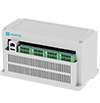
DC power converted to AC by the MGC product
02 · Who Actually Pays the Bill?
Weak grids and remote areas

This was the scenario we were asked about most this time. In places with weak grid infrastructure—remote mountain areas, islands, or mining sites, for instance—voltage and frequency fluctuate constantly. In such environments, a grid-forming PCS can actively support and establish local voltage and frequency, acting like a steady fulcrum that pulls an unstable grid back into balance. For local projects, this means power that is available and reliable—a genuine feat of engineering.
PV-storage-charging microgrids

In recent years, new-energy vehicles have visibly multiplied on Europe's streets, and ultra-fast charging stations are being built everywhere. But in many places, aging local grids cannot suddenly cope with several ultra-fast chargers running at full power at once. The solution? Use a PCS to combine PV, storage, and chargers into a local "microgrid." Storage acts as a buffer in between—neither burdening the old grid nor keeping drivers from using green power. This is a very mainstream and practical approach today.
03 · WidenEdge's European "Heat Test"
During the very weeks we were exhibiting, Europe was going through one of the most severe heatwaves on record. In France, nuclear power plants were forced to cut nearly 7% of national output because cooling-water temperatures ran too high, and the shortfall rippled all the way to neighboring Ireland, forcing the local grid operator to fire up emergency generating units; in Belgium, electricity prices at one point spiked to EUR 1,038 per MWh within a fifteen-minute evening window, setting an all-time record.
They all point to the same thing: when temperatures and electricity demand peak at the same time, the first parts of the grid to buckle are often the very pieces of equipment that no one usually pays attention to.

Heat is only one face of Europe's harsh operating conditions. Salt mist on islands, dust on construction sites, and condensation caused by day-night temperature swings are all challenges that microgrid energy-storage systems cannot avoid.
The MGC series sets its rated-power calibration point at a 45°C ambient temperature—meaning that even at 45°C, the WidenEdge PCS still delivers its rated output, with a full operating range spanning −25°C to +60°C. In project terms, this comes down to one thing: during the summer hours when electricity is most expensive and the system should be working at full load, the equipment will not "slack off" because of the heat, and the numbers originally calculated at rated output can be delivered as promised.
During the Munich show, we talked at length with Infineon's engineers about the details of applying silicon-carbide (SiC) power devices in converters—and this accumulated know-how shows up directly in the MGC series' efficiency figures: an overall CEC efficiency above 98.5%, meaning less power is turned into waste heat during conversion and, naturally, less thermal stress on cooling.
Whether it is the perennially humid air along the Nordic coast or the persistent salt-mist corrosion of southern-European island projects, the MGC series' air-intake ducting is treated accordingly, with core components rated to IP65 protection—keeping these invisible yet grinding environmental stresses outside the equipment from the start.
And when facing weak grids with unstable voltage and frequency, the WidenEdge PCS' grid-forming capability shows itself by actively holding local voltage and frequency steady when the external grid fluctuates or even fails; combined with automatic diesel-generator coordination and 100% unbalanced-load capability off-grid, it can also withstand the inrush currents at the instant high-power equipment starts up. Even in remote projects with no large grid to fall back on, it keeps the lights on and the production line moving.

What the WidenEdge PCS does within an energy-storage system is the "dispatching" work that governs energy flowing in and out. It is not the most eye-catching role on stage, but how smoothly PV, batteries, grid, and load work together rests, to a large degree, on this converter. We choose to make it a little steadier and a little cooler because what stays stable is never just the equipment—it is the real project connected at the other end.
العودة